
Ratchet & Clank: Going Mobile is the first mobile phone and only two-dimensional installment in the Ratchet & Clank series developed by Handheld Games and published by Sony Pictures Mobile. It was released on November 2 in 2005, shortly after Deadlocked.[a] There are two versions of Going Mobile, with weaker phones only supporting the Series 40 version and stronger phones being able to play Series 60.[b] The game won "Best Action Game" at the Third Annual Mobile Entertainment Awards.[1]
The game follows Ratchet and Clank are transported into a Secret Agent Clank vid-comic on the phone the player is holding in their hand[2]) through an accidentally triggered bio matter converter device, and had to make their way back out to the real world. With help from Al, they manage to build a device to restore them to normality, but run into Maximillian who was trying to use it for the same purpose to escape the vid-comic.
Going Mobile is a 2D sidescroller, without the core third-person view gameplay, focusing on light platforming and combat engagements against a total of four enemy types, one of which is the Megacorp Chickenbot, as well as a final boss. Players cannot level their nanotech, but they can upgrade weapons through using them to destroy enemies, as well as collect bolts to purchase ammo and new weapons at a vendor. Players can also enter The Arena and fight in various challenges to earn bolts and level their weapons, and almost all levels contain hidden titanium bolts, which when all of them are collected, award the player with a powerful weapon.
Although Going Mobile is not canon, it appears to take place after Up Your Arsenal, as the cover art has Ratchet wearing the Aegis Mark V armor and wielding the N90 Hurricane, and the Secret Agent Clank holovision series is an important factor in the game's plot. Additionally the game features Ace Hardlight posters, indicating it does not take place after Deadlocked, and also reuses four weapons and one enemy from Going Commando.
Plot[]
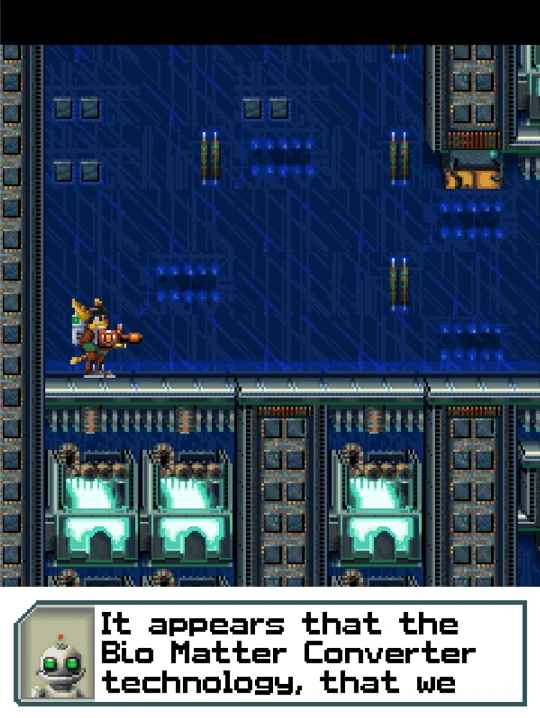

Ratchet and Clank upon entering the vid-comic.
The game begins with Ratchet and Clank being transported into a new bio matter converter, while previewing the technology, which had accidentally triggered. They found an infolink, with which they could access the rest of the galaxy's information network, allowing them to access another electronic device and communicate with the analog world.[3] The device they entered turned out to be a Secret Agent Clank vid-comic, in the first area of which, Circuit Circuit, they collected ammunition and found a software module that allowed Clank to extend his arm, functioning as a grapple gun. They ventured deeper into the software through another infolink, and Clank accessed the storage subsystems, allowing Ratchet to access a weapons store.[4]
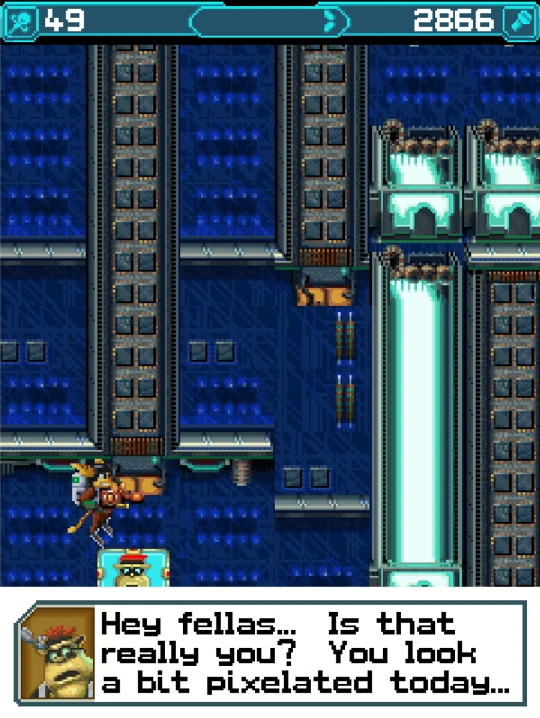

Contacting Al.
In Battleland they found another infolink leading back to the operating system, and an area that allowed them to access the communications system, they also unlocked a virtual battle arena.[5] A locked door in the Communication Station forced them to take a detour to the Security BIOS to unlock it.[6] Upon their return they found a communications port and managed to contact Al. They explained their predicament and inquired as to how to reverse it, which Al proclaimed would be easy.[7]
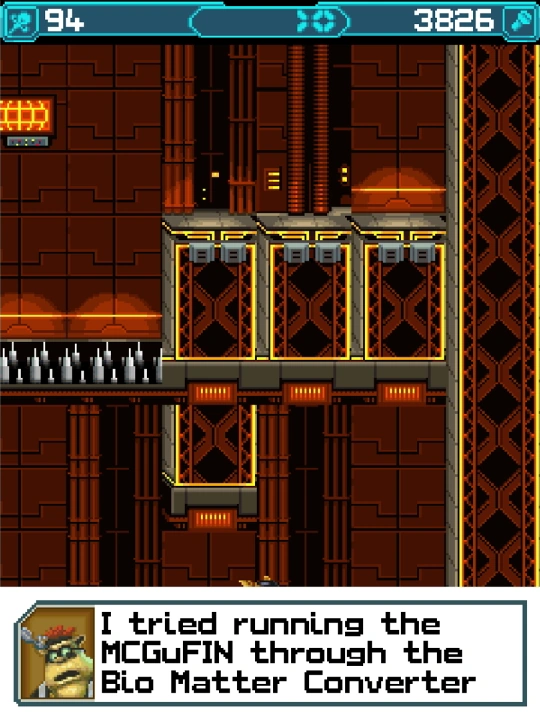

Contacting Al again.
Al stated that they had to run their digital corporeal data through a Macro Corporeal Geo Fragmention Ion Negator (or MCGuFIN), reversing the biodigitzation process, and allowing them to return to the analog world. Al was reluctant to help them out at first, as he had planned to play his 'Amoeboids and Anterchambers' game, but resolved to help them out with the MCGuFIN he was using as a doorstop.[7] Upon collecting the first part of the device they found out Al ran into an error in the transmission, as a power surge caused it to be split into six pieces, and spread throughout the vid-comic issue. He also opened several infolinks to more nodes, allowing them to further explore the network.[8]
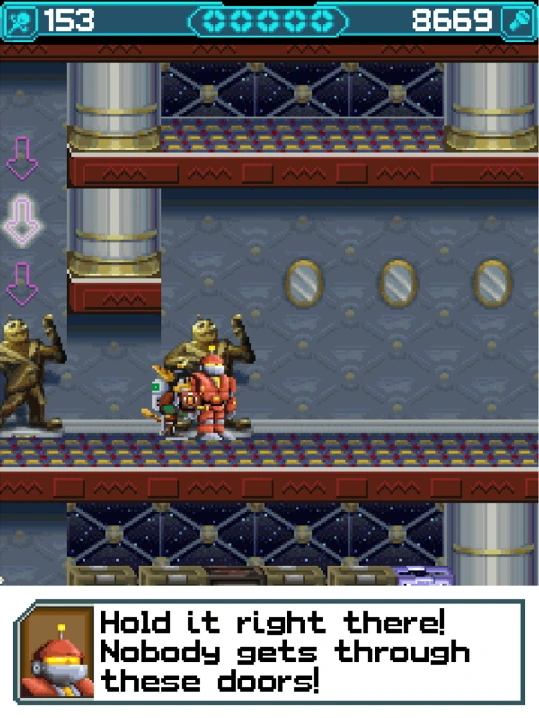

Bribing the bouncer.
After collecting all pieces and returning to the Communication Station they spoke with Al again, who said that to activate it they had to access a special infolink in a secure area. The codes to which were kept in a safe at another location, specifically Maximillian's office at the Maktar Casino. A robot bouncer blocked their way however, but Al confided in them that they could be bribed, and that the only way to get enough cash was to enter the Battle Arena's pay-off vault, which was protected by a barrier. He had a solution however, and granted Ratchet the Circuit Jammer, allowing him to enter the vault.[9]
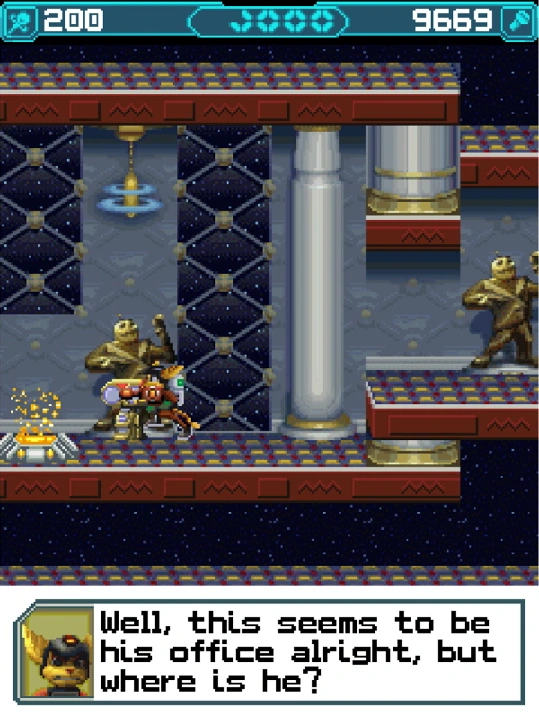

Entering Maximillian's office.
After collecting the Payola from the vault, and bribing the bouncer, they managed to reach the office, which turned out to be empty. Clank saw that the security systems indicated Maximillian had already left, with an infolink leading back to their final destination. Clank also found codes that were left behind, which functioned as a static barrier passage, allowing them to pass through static fields.[10]

Meeting Maximillian.
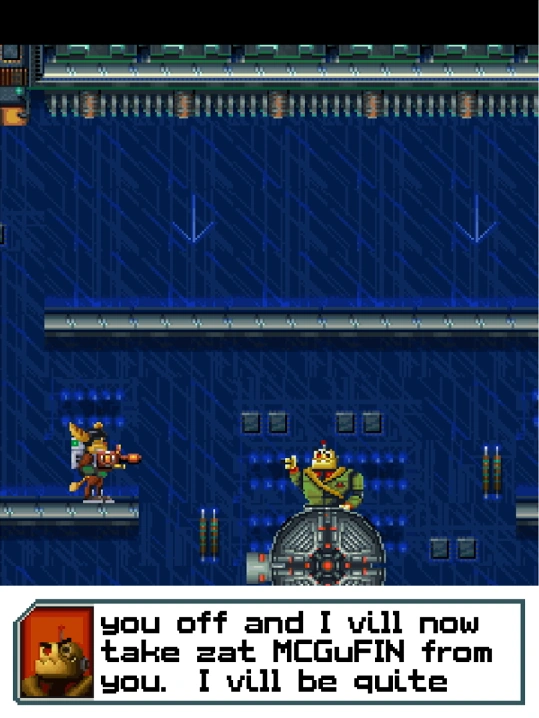
In the second visit to the Security BIOS they found a second lead to another high security OS area, beyond which lies the exit to the real world. Ratchet and Clank worried that if Maximillian were to succeed, there would be yet another criminal mastermind in the real world.[11] They finally found Maximillian in Goldsprocket, who proclaimed he would turn 'Agent Clank' into scrap metal, after which he would use the MCGuFIN and enter the real world. He was ultimately unsuccessful however, for Clank and Ratchet defeated him. Right before using the MCGuFIN to transmute themselves back into the real world, Ratchet asked him where he thought they would emerge, to which Clank answered "Unknown.".[12]
Gameplay[]

Ratchet using the Boar-Zooka.
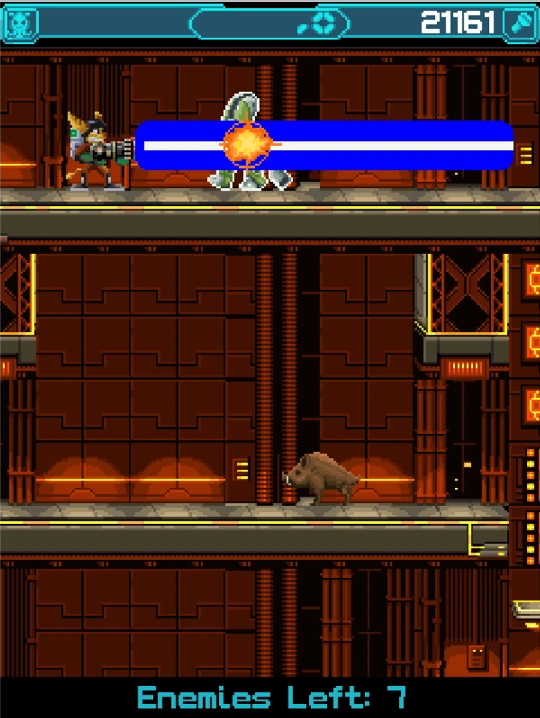
Gameplay in Going Mobile is largely similar to that of the normal games in the series, albeit limited to 2D. Ratchet can shoot and hit enemies as well as bolt, nanotech and ammo crates to collect the respective contents. Weapons level up, to a maximum of v3, which improves their damage and changes the bullet (or equivalent) design for some weapons, but they do not upgrade into a more powerful form. Ratchet starts with the Lancer, and future weapons are either bought at the Weapons Store, received for progressing the plot, or other optional objectives such as completing all arena challenges or collecting all titanium bolts.
Ratchet posses most of his normal moves, he can smash his OmniWrench down to hit enemies or bolt locks to unlock doors, as well as use a Hyper-Strike to hit targets below him. He can jump and double jump, the latter of which will allow him to glide using the Heli-Pack (though gliding automatically takes him forwards). Enemies hit by an attack are temporarily staggered, or stunned for longer if he jumps on-top of them. If he attempts to shoot an enemy while in melee range he will swing his wrench instead.
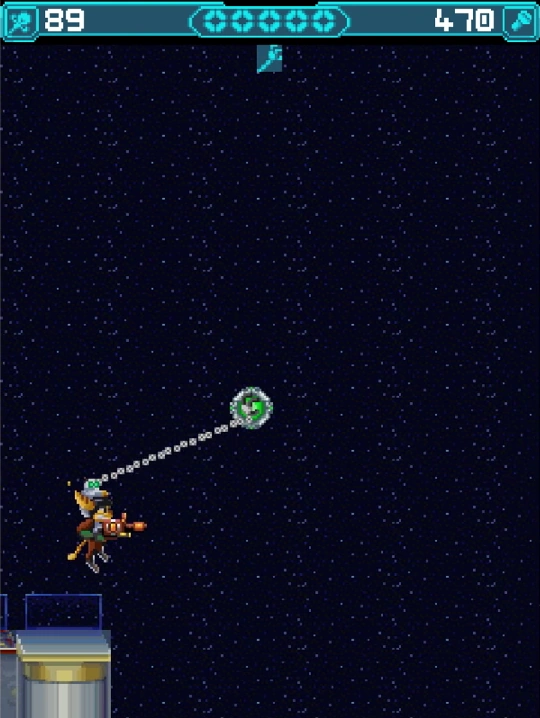

Clank's grapple ability gameplay.
The only gadget he actually obtains is a grapple ability, which is similar to the Swingshot, but works by extending Clank's arm to grapple targets, which function as versa-targets. He cannot manually swing when attached to the target however, and can only attach within a fixed distance. He also can grind on grind rails, indicating he is wearing the Grind Boots.
| Location | Par time |
|---|---|
| Circuit Circuit 1 | 0:02:40 |
| Battleland 1 | 0:02:00 |
| Communication Station 1 | 0:02:40 |
| Security BIOS 1 | 0:02:30 |
| Communication Station 2 | 0:02:10 |
| Circuit Circuit 2 | 0:02:40 |
| Battleland 2 | 0:02:10 |
| Maktar Casino 1 | 0:01:40 |
| Burnout Murderbowl | 0:02:20 |
| Data Mainframe | 0:03:40 |
| Megakill Blast Arena 1 | 0:03:00 |
| Silver Diode | 0:03:00 |
| Communication Station 3 | 0:00:30 |
| Megakill Blast Arena 2 | 0:01:50 |
| Maktar Casino 2 | 0:02:20 |
| Security BIOS 2 | 0:02:20 |
| Central Receiver Uplink | 0:05:00 |
At the end of each level you receive your total score, which is affected by the number of enemies killed and how long you took to reach the end. You receive bonus points if you beat the par time, as well as a 'pacifist' bonus if you kill no enemies.
Enemies[]
Going Mobile only features four enemies, one of which is the Megacorp Chickenbot, with the others being the 'patrol bot', 'explodo', and an automated turret. Enemies can be harmed with either the OmniWrench or any of the available weapons, the Chickenbot and patrol bot can also be jumped upon, which temporarily stuns them. Each hit from a weapon will also stagger enemies for a moment, making high rate of fire weapons useful for their ability to stunlock enemies, whereas those with an area of effect or piercing attack achieve a similar outcome, by hitting multiple enemies in a row, ensuring those behind the front cannot attack you from a distance.
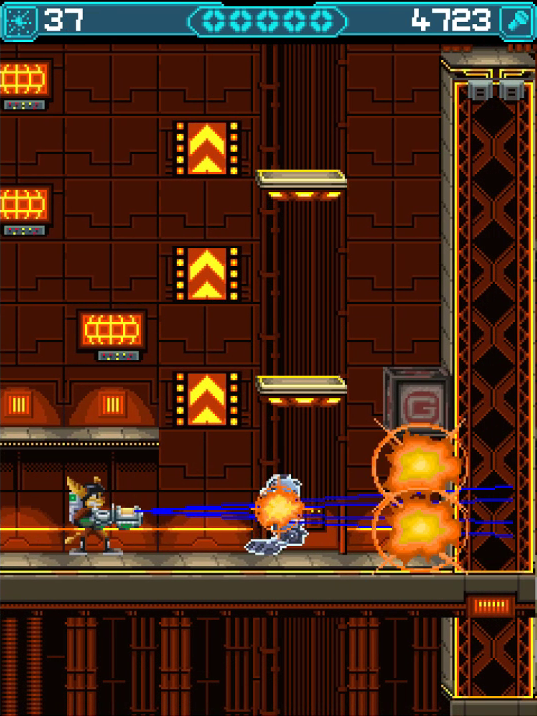

Ratchet using the Defragmenter on a Chickenbot.
Chickenbots will repeatedly walk back and forth on their route, only turning around if they run into a wall or gap, and only attacking if they run into Ratchet. Patrol bots are humanoid green robots and function similarly, but will use their ranged weaponry (either a burst of three bullets, or a single rocket, with the latter being thrice as strong as a single bullet) if they spot Ratchet. They will not, however turn around when shot in the back. They are most dangerous when in pairs, as one can stand behind the other and rely on it to soak up any damage, leaving it free to attack Ratchet.
Explodos are small droids using a hopping mechanism to move around, they are somewhat faster than Chickenbots, and will actively turn around to attack Ratchet if they can, as well as jumping down from platforms if they see him. Their attack deals a lot of damage, but requires them to reach melee range, at which point they will blow themselves up. They are deadly when in large groups, at which point a piercing weapon is best to avoid those in the rear using the front as cover.
Lastly are the automated turrets, which are immobile and not particularly durable, but can be mounted on the walls and ceiling, giving them an extra angle of attack vector, unlike normal enemies which can move but cannot target enemies above or below them. Turrets will automatically shoot right, up, left and then repeat this cycle, which means they can thus hit Ratchet if he is above or below them. Each turret shoots either a burst of three bullets, a single rocket, or a single gravity bomb, which like the real weapon, is subjected to gravity and will thus fall down.
Locations[]
Ratchet will visit each location in turn, the completion of which opens up access to a new area. Travel is done by using infolinks, which function as teleporters from and to the hub and each level. He eventually receives the Defragmenter and a static barrier passage, with which he will revisit older levels and make more progress into them. Infobots are also present, which allow communication with the real world. He always has access to the Weapon Store at the start of the game after Circuit Circuit, where weapons unlock as he progresses through the other levels.
In each level Ratchet will travel from left to right, with some minor deviation possible, to reach the end, where often an infobot resides, progressing the plot, and an infolink to return to the hub. Levels contain enemies, as well as normal hazards such as spikes, or floating electric balls. There are only four distinctive sets of level art design, though actual gameplay design can vary, with some focusing more on natural hazards and others on enemies, and later levels employing a mix of both.
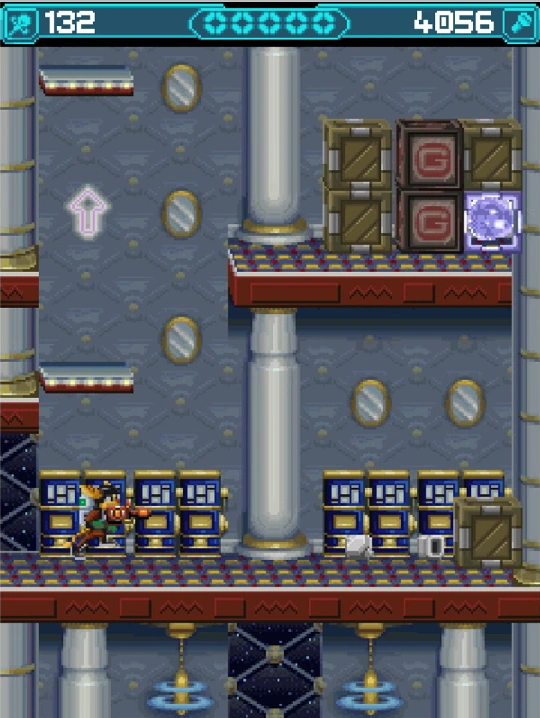

Circuit Circuit.
All of the levels in Going Mobile are using one of three possible aesthetic designs. The first level is Circuit Circuit, which has a rich color theme primarily using blue, silver and yellow, as well as slot machines, statues of Maximillian, carpeted floors, chandeliers, and aesthetic support pillars with a roman design. Said design also features in the revisit to Circuit Circuit, which only features more enemies, and the Maktar Casino. The Maktar Casino's most notable feature is the use of larger and more open spaced chambers. Silver Diode also uses the same aesthetic design.
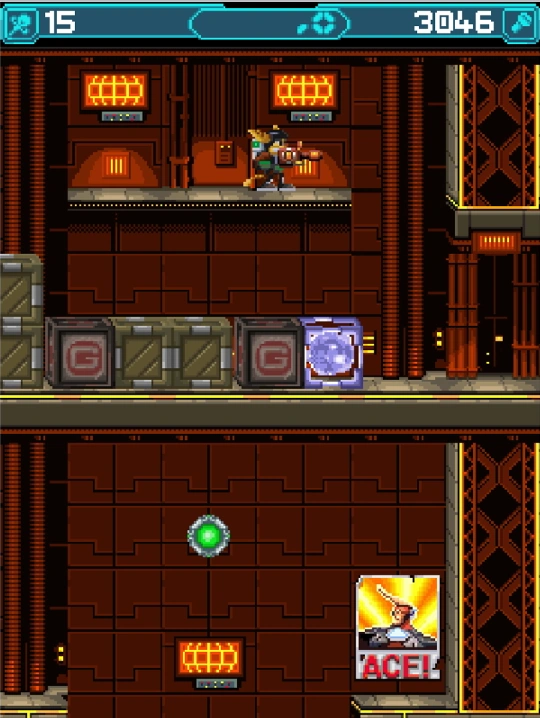

Battleland.
Battleland, and the subsequently-visited Battle Arena, or The Arena, Burnout Murderbowl, and Megakill Blast Arena all feature the the same brown, dark red, and orange color scheme. The overall design also has many flashing arrow indicators and posters of Ace Hardlight in the background. The Megakill Blast Arena's first visit leads along two possible paths, although the top route requires the Circuit Jammer, but does not contain anything notable in itself, at the bottom end is the vault containing the Payola.
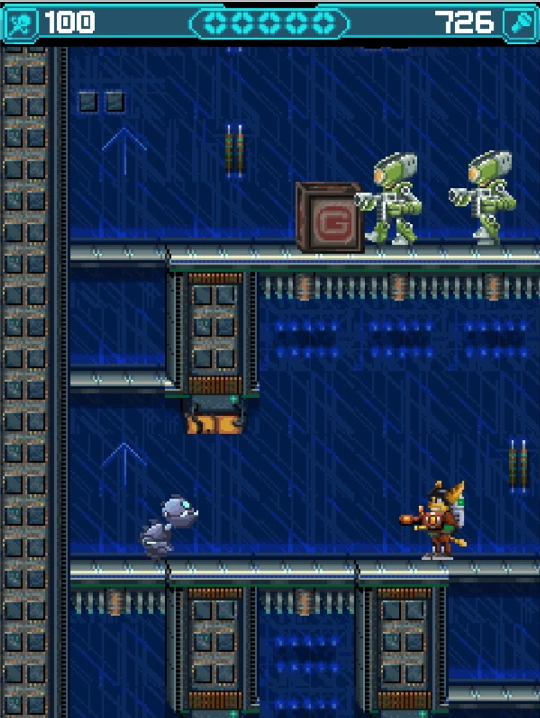

Communication Station.
The Communication Station has a predominantly dark-blue background and many silver platforms. At times there are a sparse few columns with what appears to be energy contained in a clear material akin to glass. The Communication Station's first part has a very high security in the form of spikes, moving platforms and automated turrets, whereas the second visit features many more turrets mounted onto the walls and ceilings. The Security BIOS, Data Mainframe, Central Receiver Uplink and finally Goldsprocket also use the same design. Specifically Data Mainframe has less security, but is quite long, and has more and thicker walls that encapsulate some of the aforementioned tall energy cylinders.
Series 40 differences[]
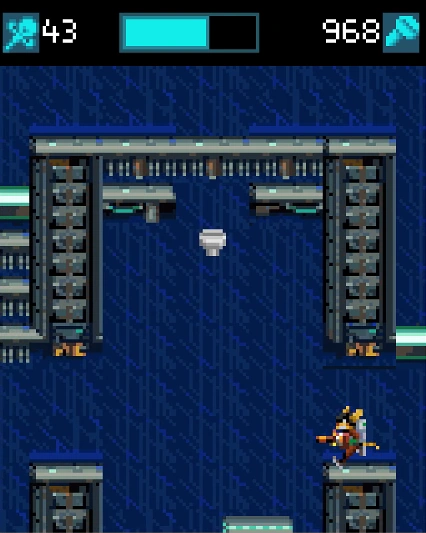

A titanium bolt in the Series 40 version.
At its core design the Series 40 version is largely the same, but in reality it is an almost entirely different game than the full edition of Going Mobile. The first difference is the change in the start screen and main menu theme, followed by the complete change in graphics as everything is much more pixelated. All sounds have been changed and more simplified, and the nanotech meter is now a single bar. The plot has been radically shortened, essentially completely ignoring the plotline involving Maximilian and the MCGuFIN, and simply involves Ratchet following Al's direction to run their digital corporeal data through the Macro Corporeal.
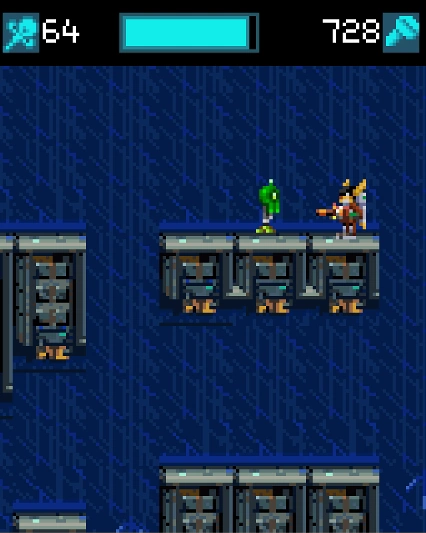

A green explodo in the Series 40 version.
Both the relatively non-linear level hub and the arena no longer exist, and Clank starts with the grapple ability by default. All weapons can only be gained through buying them from the simplified weapons store (something that requires more bolts than you can feasibly gain throughout a normal playthrough), excluding the R.Y.N.O. which still requires collecting titanium bolts. There are only nine titanium bolts in the game however, instead of the normal 31. Both the enemies and the final boss remain functionally the same, except for the explodo which is now colored green.
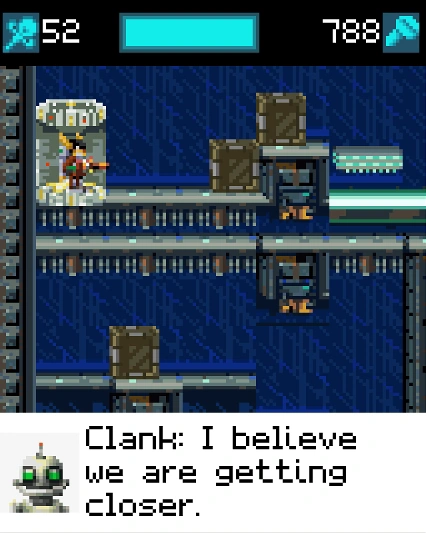

A cutscene in the Series 40 version.
All locations now feature the same color scheme from the Series 60's Communication Station, although none feature the same level design, making them entirely different in effect. Battleland, Communication Station, Security BIOS, Data Mainframe and Silver Diode are included. While new levels such as Power Alley, Macro Corporeal, and Main Display were added, with everything else not being in the game at all.
Development[]
Handheld Games made Going Mobile without any interaction with Insomniac Games, despite being eager to collaborate. Instead, Sony gave feedback, although they were less familiar with the Ratchet & Clank license than Handheld Games themselves, as part of the developer team was a big fan of the source material.[13] Insomniac was not involved in the initial concept either, with the initial pitch for the game likely being a collaboration between Handheld Games' CEO Thomas Fessler, the executive producer Seth Rosenfeld, and their Sony Producer contact Shereef Morse.[14]
Wiggins was given the concept of Ratchet and Clank being trapped in your phone. Seth Rosenfeld insisted on making a pun out of naming the main plot device "McGuffin", which ended up becoming the MCGuFIN.[15] He then worked on the level design, which he based on the main series' feature on revisiting past worlds, but instead limited it to revisiting old levels at different starting points and with their own distinct themes. He tried to at least include some memorable themes and segments that would stand out.[16]
The game received several awards, which was attributed due it benefiting from Ratchet's double jump and hover ability, where most phones did not register multiple button presses at the time. This is also why the melee attack moved you forwards.[17] Rosenfeld was also responsible for playtesting, and improving the original dialogue.[18] Shereef would also recommend all sorts of features, such as wall climbing anti-gravity areas, although these did not always pan out.[19]
Ben Hopper, an artist for the game, and also helped with general game design. They had to reduce the scope of their original vision, due to the limitation of mobile phones at the time. [20] An in-house Sony artist did the Maktar Casino level artwork themselves, as they did not like the work produced by Handheld Games.[21]
Canceled sequel[]
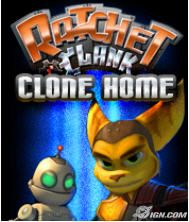

Cover of the canceled sequel.
Ratchet & Clank: Clone Home was a game for mobile phones planned to be released on September 1, 2006, but it was canceled. It was not developed by Handheld Games[22] although it still continued the Going Mobile setting. A preview of the game, dated June 16, 2006, stated that the plot involved Ratchet and Clank miniaturizing themselves to attack some "imitators they do not find flattering." It also claimed that Clone Home contained fifteen levels, and would offer more weapons than Going Mobile, and supplied six screenshots.[23] Much like its predecessor, beating it was to unlock a skin in another game[24], though it is unknown what game it was intended to be compatible with.
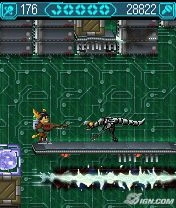

Gameplay of Clone Home.
It is unknown why Clone Home was canceled, though some speculate that it was possibly due to it being too similar to the plot of Size Matters which featured a similar story also containing miniaturization and clones. This has never been confirmed, however, and the validity of this theory is questionable due to the fact that the game was announced after the reveal of Size Matters. In November of 2021 a member of the Lost Media Wiki contacted a Javaground employee that worked on the game, who revealed the game reached "gold master" status - meaning the game was finished - but simply never released.[25]
The cover of the game is copied from Deadlocked, as Ratchet wears the marauder armor and holds the same pose.
Gallery[]

Notes[]
Annotations[]
- ↑ You can acquire two exclusive skins of Eugene and the renegade armor for its multiplayer mode. First complete Going Mobile, then select 'Get Ratchet Skin' from the main menu and enter your personal multiplayer name. This generates a pair of simple directional button press codes, each of which unlock the relevant skin.
- ↑ This article will mostly describe the Series 60 version; for the Series 40 version, see #Series 40 differences
Citations[]
- ↑ Gamasutra 2006
- ↑ Deadlocked, game manual (NTSC), p. 52
- ↑ Going Mobile script § "Prologue"
- ↑ Going Mobile script § "Circuit Circuit (first visit)"
- ↑ Going Mobile script § "Battleland"
- ↑ Going Mobile script § "Communication Station (first visit)"
- ↑ 7.0 7.1 Going Mobile script § "Communication Station (second visit)"
- ↑ Going Mobile script § "First four MCGuFIN pieces"
- ↑ Going Mobile script § "Communication Station (third visit)"
- ↑ Going Mobile script § "Maktar Casino (second visit)"
- ↑ Going Mobile script § "Security BIOS (second visit)"
- ↑ Going Mobile script § "Epilogue"
- ↑ Brad Wiggins 2019, "We ended up making the game without any interaction with Insomniac, even though we would have been eager to collaborate. Sony themselves would sometimes give us feedback, but they were less familiar with the license than everyone on the team at handheld (I personally played through the first 3 games as research for this one). Specifically our producer was a big fan, and wouldn't have let us do anything other than be true to the source material."
- ↑ Brad Wiggins 2019, "I don't believe Insomniac was involved in the initial concept of the game at all. As I remember, they declined to be involved or offer feedback, whenever the opportunity was given to them. I think the initial pitch for the game was likely a collaboration between Handheld Games' CEO Thomas Fessler (who liked to pitch ideas a lot), with Handheld Games' Executive Producer Seth Rosenfeld and our Sony Producer contact Shereef Morse (the two of whom had become pretty good friends by this point, and were both usually on the same page as far as taste in games and both really knowledgeable fans of the Ratchet & Clank franchise)."
- ↑ Brad Wiggins 2019, "The concept given to me to work off of was that Ratchet & Clank get trapped in your phone and have to escape. It was Seth's insistence that we make a pun out of naming the central device "McGuffin"."
- ↑ Brad Wiggins 2019, "The concept given to me to work off of was that Ratchet & Clank get trapped in your phone and have to escape. It was Seth's insistence that we make a pun out of naming the central device "McGuffin". From there it was my responsibility to plan how that would work, and what the level content would be like. The PS2 games feature a lot of revisiting of past worlds, but since this was for mobile, we wanted to make it a little more intuitive and instead settled for something that feels more like distinct levels (even though you are actually revisiting the same level files as before, just at different starting locations). We didn't really have a lot of space to work with to make immersive and diverse areas that felt memorable and alive... so I tried to at least have memorable level themes and segments that would stand out. "
- ↑ Brad Wiggins 2019, "But given that competing platformers on mobile were unplayable, we ended up getting IGN awards for Wireless Platformer of the year 2005 Editors choice, as well as the same award in Player's choice. We also won best action game of 2005 from Gamespot's "mobies" awards. We really benefited from ratchet having a triple jump and hover, which allowed the player to move forwards and jump at the same time, when most phones didn't register more than one button press at a time."
- ↑ Brad Wiggins 2019, "Seth Rosenfeld also helped a lot with the early design, and improved a lot of my original dialog. He also played it a lot during development and pointed out where some of my levels weren't working."
- ↑ Brad Wiggins 2019, "Shereef used to also pitch all sorts of features to us he'd like to see, like wall climbing anti-gravity areas, leveraging code from Spiderman... but was quick to understand when it wasn't looking like it would work out."
- ↑ Brad Wiggins 2019, "The artist and my close friend, Ben Hopper was also a huge fan of the series, and was a great person to bounce ideas off of for enemies, environments, and even gameplay. We had to vastly reduce the scope of the vision both of us had for the project, based on the realities of mobile phones at the time."
- ↑ Brad Wiggins 2019, "The casino level artwork in going mobile was done by an in-house Sony artist, who didn't like the art we produced, so that's why I believe that they did a lot of it in-house rather than hiring another developer..."
- ↑ Brad Wiggins 2019, "Sadly I've never myself seen or played Clone Home. I was under the impression that Sony used our code and our editor, and just made new art and levels themselves (not that they looped us in on this plan at all)..."
- ↑ IGN 2006
- ↑ Screenshot of the title screen provided by the Lost Media Wiki.
- ↑ Lost Media Wiki article on Clone Home.
References[]
- Dobson, Jason (2006, April 6). Third Annual Mobile Entertainment Awards Winners Announced. Archived from the original on 30 August 2019.
- (n.d.) . "Ratchet & Clank: Clone Home". From IGN. Archived from the original on 5 september, 2019.
- Wiggins, Brad [@TheGoldenBolt] (2019, May 17). Ratchet & Clank's Ambitious Phone Game - Ratchet & Clank: Going Mobile [Video]. YouTube.